If you run a local business, you’ve probably wondered whether all that effort chasing down reviews is actually doing anything for your search rankings, or if it’s just good for your ego and your Yelp page. It’s a fair question. Reviews take time to collect, they’re unpredictable, and a single bad one can feel like it undoes months of work.
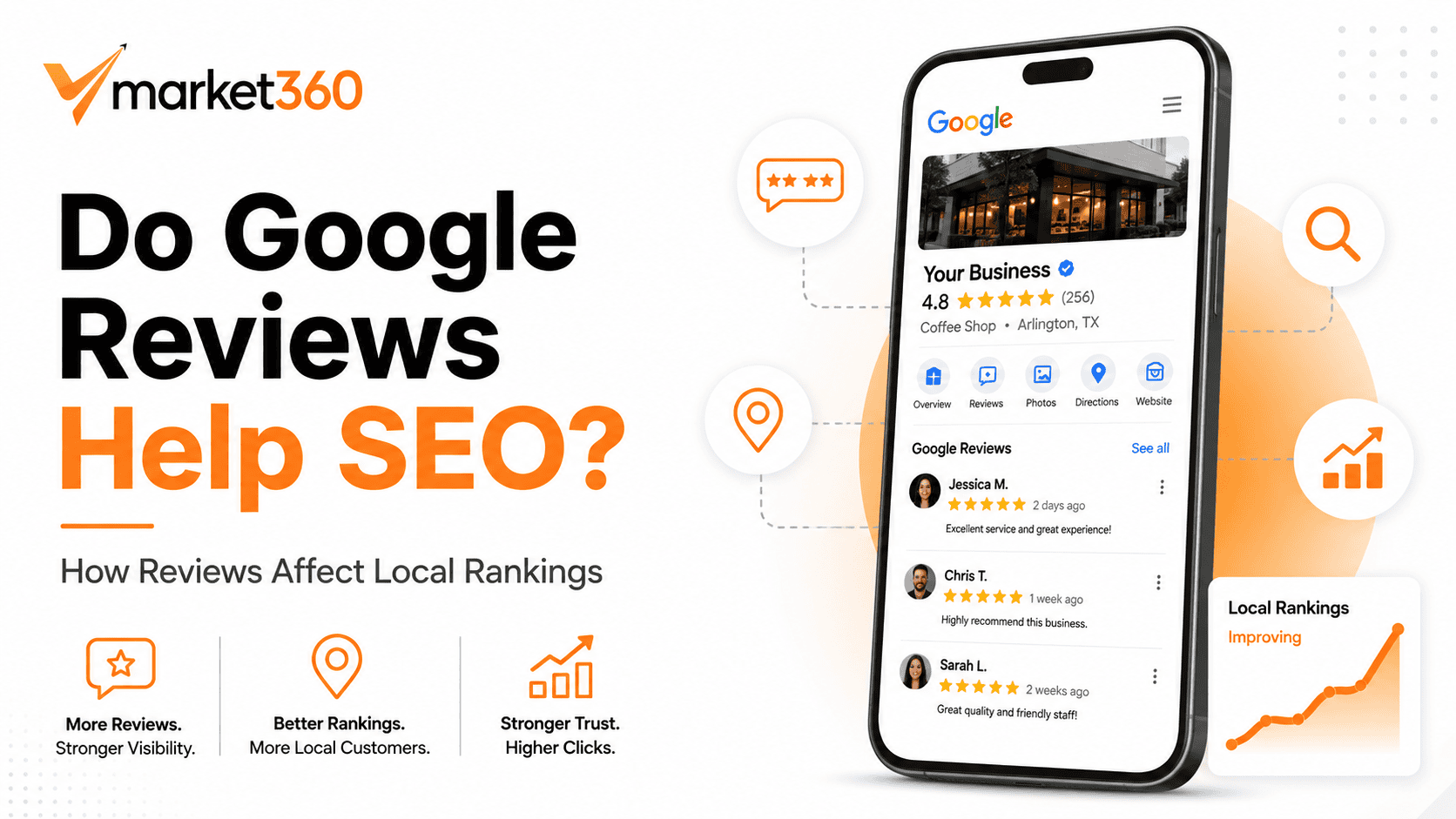
Here’s the short answer: yes, Google reviews help SEO, but not in the simple, direct way most business owners assume. They matter enormously for local search visibility, they influence how people click and choose between businesses, and in 2026, they’re starting to shape how AI tools like ChatGPT and Google’s AI Overviews describe your business too. What reviews don’t do is directly boost your website’s organic rankings the way a backlink or a well-optimized page does.
We’ve spent years managing Google Business Profiles for businesses across Arlington, Dallas-Fort Worth, and beyond, including profiles that had been suspended, neglected, or never properly set up in the first place. What follows isn’t theory pulled from a single source. It’s the pattern we see repeatedly across real client accounts, backed up by what Google itself says publicly about how local ranking works.
Table of Contents
- Do Google Reviews Actually Help SEO?
- How Google’s Local Algorithm Works
- The Three Pillars of Local SEO
- How Reviews Affect Local Rankings
- Review Count vs. Star Rating
- Why Review Recency Matters
- Does Replying to Reviews Help SEO?
- Review Keywords and Relevance
- Do Reviews Affect Organic SEO?
- Reviews and Conversions
- Google Reviews and AI Search in 2026
- Common Google Review Myths
- Can Fake Reviews Hurt Rankings?
- How Many Reviews Do You Need?
- Reviews vs. Other Ranking Factors
- How to Get More Reviews
- Review Strategy Checklist
- Common Mistakes to Avoid
- Key Takeaways
- Frequently Asked Questions
Do Google Reviews Actually Help SEO?
Yes, but the honest answer has two layers to it, and most articles on this topic collapse them into one confusing blur.
For local search rankings (the Google Maps results and the “local pack” that shows three businesses under a map when you search something like “plumber near me”), reviews are a confirmed, direct ranking signal. Google’s own Business Profile Help documentation states plainly that prominence, one of the core ranking factors, is influenced by how many reviews a business has and how positive they are, alongside links and general online presence.1
For traditional organic rankings (the regular blue links you see when you search something that isn’t location-specific), reviews don’t have a confirmed direct effect. Their influence here is indirect, working through click-through rates, brand trust, and the kind of authority signals that Google’s Helpful Content systems have increasingly rewarded since the update in early 2024.
If you’re a local business, the local ranking impact is the one that matters most to you, and it’s substantial.
How Google’s Local Ranking Algorithm Actually Works
Before we go deeper into reviews specifically, it helps to understand what Google is actually trying to accomplish every time someone runs a local search. When someone searches “best Italian restaurant open now” or “emergency plumber near me,” Google’s job is to surface businesses that are genuinely relevant, nearby, and trustworthy, in that order of consideration.
Google doesn’t rank local businesses the same way it ranks web pages for informational searches. There’s a separate set of signals at play, built around three core pillars that Google itself has named publicly through its own documentation.
The Three Pillars of Local SEO: Relevance, Distance, and Prominence
Relevance measures how well your business matches what the searcher is looking for. This comes from your Google Business Profile category selection, your business description, the services you’ve listed, and increasingly, the content of your customer reviews.
Distance is exactly what it sounds like: how close your business is to the searcher’s location, or to the location they’ve specified in their search. Google’s own documentation confirms this is calculated relative to the searcher’s actual or specified location, and it’s the one factor a business genuinely can’t influence directly.1
Prominence is where reviews live. This is Google’s measure of how well-known, established, and trusted your business appears to be, both online and offline. Google specifically cites review count and rating as contributing factors here, alongside backlinks and general web presence.1
Here’s the practical reality for most small business owners: you can’t move your physical location, and building significant website authority takes years of consistent work. Your review profile is the local ranking factor you have the most realistic ability to influence quickly. In our own client work, this is consistently the fastest-moving lever available, faster than technical SEO fixes, faster than content, and far faster than link building.
How Reviews Specifically Affect Your Local Rankings
Breaking prominence down further, here’s what specifically happens when your review profile improves:
Higher review count signals established trust. All else being equal, a business with hundreds of reviews reads as more established and lower-risk to both Google’s algorithm and to searchers than a business with a handful of reviews, even if that smaller business has a slightly higher average rating.
Review content becomes indexed, searchable text. When customers mention specific services, products, or details in their reviews, that language becomes part of the text Google associates with your business listing.
Fresh reviews signal an active, current business. Industry ranking factor surveys, including Whitespark’s annual local search study, consistently list review recency and velocity among the top signals correlated with local pack rankings.
Review responses create additional fresh content. In practice, we’ve noticed that profiles with a consistent response habit tend to also show stronger review velocity over time, likely because customers notice the business is actually paying attention.
Review Count vs. Star Rating: Which Matters More?
This is one of the most common points of confusion, and the data consistently points in one direction: volume tends to outweigh a marginally higher rating.
A business with 200 reviews and a 4.7 average will typically outrank a business with 15 reviews and a 4.9 average, all else being equal.
There’s an interesting wrinkle here too: a perfect 5.0 rating can actually work against you from a conversion standpoint, even if it doesn’t hurt your ranking. Consumers have grown skeptical of flawless ratings. We’ve seen this play out directly with clients: a profile that went from a “perfect” 5.0 with 8 reviews to a 4.7 with 60 reviews saw stronger engagement, not weaker, once the volume built up.
Why Review Recency Matters More Than Most Businesses Realize
It’s easy to build up a strong batch of reviews early on, feel satisfied with the result, and stop actively asking for more. This quietly costs businesses ranking position over time.
Google’s local algorithm appears to favor businesses with a consistent, ongoing flow of reviews over businesses with a large historical count but no recent activity. This is one of the most common gaps we find during a Google Business Profile audit: a strong review count built two or three years ago, followed by near silence since, while a newer competitor with fewer total reviews but consistent monthly activity has quietly overtaken them in the local pack.
Does Replying to Google Reviews Help SEO?
Yes, in a few concrete ways, even though the effect isn’t as direct as review count or rating. Responding to reviews, especially negative ones, sends an engagement signal to Google that your business is actively managed. It also creates additional indexed content on your profile.
A response won’t change your rankings overnight, and it’s not a substitute for actually generating more reviews. But it’s a low-effort, high-value habit that compounds over time.
Review Keywords and Local Relevance
When customers describe their experience in a review, the specific words they use become part of the text associated with your Google Business Profile. A roofing company whose customers repeatedly mention “storm damage repair,” “insurance claims,” and same-day service in their reviews is building organic relevance for those exact phrases, without any of that language ever appearing on the company’s own website.
You can’t script this, and asking customers to include specific keywords crosses into manipulative territory that Google explicitly discourages. What you can do is make sure your team is doing great, specific work worth mentioning.
Do Reviews Affect Organic (Non-Local) SEO?
For traditional organic search results, reviews don’t have a confirmed, direct ranking effect. Their influence here is indirect, but it’s still real. Reviews and testimonials displayed on your actual website contribute to the kind of experience and trust signals Google’s Helpful Content system emphasizes. Reviews also affect click-through rate, which does have a documented relationship with rankings over time.
Reviews and Conversions: The Business Impact Beyond Rankings
Rankings matter, but they’re not the actual goal. Getting found is only useful if it leads to someone actually contacting you, and this is where reviews do some of their most important work, separate from any algorithm.
A strong review profile shortens the trust-building process a potential customer would otherwise go through on their own. Someone comparing three plumbers in a local pack isn’t just looking at who ranks first. They’re reading a handful of recent reviews to decide who to actually call, often within seconds.
This is also where review responses pull double duty. A thoughtful reply to a negative review, visible to every future reader of that review, often does more to build trust than the negative review does to damage it.
In practice, we treat review strategy as a conversion tool first and an SEO tool second, even though both matter. A business ranking first with weak reviews often converts worse than a business ranking third with a strong, active review profile.
Google Reviews and AI Search in 2026
AI-powered search tools, including Google’s own AI Overviews and third-party tools like ChatGPT, Gemini, and Perplexity, increasingly pull from review data when generating summaries or answering questions about local businesses.
Industry research tracking 2026 local ranking behavior notes that Google increasingly treats a Business Profile as a live dataset, one that gets read, summarized, and surfaced by AI systems in near real time, rather than a static listing checked occasionally. A profile that goes untouched for months doesn’t just stagnate quietly anymore. It actively loses ground as AI systems favor businesses with fresher, more complete data to draw from.
Review recency, response habits, and content quality aren’t just ranking factors anymore. They’re the raw material AI tools use to describe your business to potential customers who may never see a traditional search result at all.
Common Google Review Myths
Can Fake Reviews Hurt Your Rankings?
Yes, and the risk has grown significantly. Google’s fake review detection systems have improved considerably, and the consequences range from individual reviews being removed to entire profile suspensions, which we’ve covered in detail in our guide on recovering a suspended Google Business Profile.
Buying reviews, running incentivized review campaigns without proper disclosure, or asking employees and family members to post reviews all fall into risky territory. Beyond the direct penalty risk, fake or incentivized reviews tend to read as generic and vague.
How Many Google Reviews Do You Actually Need?
There’s no universal magic number. What matters is your volume relative to your direct competitors in the local pack. Search the terms your ideal customers would use, look at the top three to five businesses that show up, and note their review counts and ratings. That range gives you a realistic target for your specific market.
Reviews vs. Other Local Ranking Factors: A Comparison
| Ranking Factor | How Directly Controlled | Time to Improve | Cost |
|---|---|---|---|
| Reviews (count, rating, recency) | High control | Weeks to a few months | Low, mainly time |
| Google Business Profile completeness | High control | Days | Low |
| Physical location/distance | No control | N/A | N/A |
| Website domain authority | Moderate control | Months to years | Moderate to high |
| Local citations (NAP consistency) | High control | Weeks | Low to moderate |
| On-page SEO and content | High control | Weeks to months | Moderate |
| Organic Review Growth | Paid Local Ads | |
|---|---|---|
| Ongoing cost | Low (mainly time) | Ongoing per-click/impression cost |
| Effect on rankings | Direct, cumulative | None on organic/local rankings |
| Longevity | Compounds over time | Stops when spend stops |
| Trust impact | High, seen as authentic | Neutral to lower |
How to Get More Google Reviews the Right Way
Ask at the right moment. The best time to ask is immediately after a positive interaction. Waiting days or weeks dramatically reduces response rates.
Make it easy. A direct link to your review page, sent by text or email, removes almost all friction.
Train your team to ask consistently. This shouldn’t depend on one person remembering.
Never offer incentives for positive reviews specifically. This violates Google’s policies and puts your entire profile at risk.
Respond to every review, positive and negative. This reinforces the engagement signal discussed earlier.
Follow up after resolving a complaint. It’s reasonable to ask if a customer would consider updating their review to reflect the resolution.
A Practical Google Review Strategy Checklist
- Google Business Profile is fully completed, including categories, services, and business description
- A simple, direct link to leave a review is set up and easy to share
- Your team has a consistent process for asking after positive interactions
- You respond to reviews within a few days, both positive and negative
- You’re tracking review count and rating relative to your top 3-5 local competitors
- No incentivized or purchased reviews are part of your strategy
- Review requests go out consistently, not just in occasional pushes
- Negative reviews are addressed professionally, with a resolution offered where appropriate
Common Mistakes That Hurt Your Review Profile
Going quiet after an initial push. A burst of reviews followed by months of silence looks worse than slow, steady growth.
Ignoring negative reviews. Unanswered criticism sits publicly on your profile indefinitely.
Buying or incentivizing reviews. These tend to read as generic and don’t provide genuine keyword relevance.
Treating review management as a one-time project. Businesses that treat it as routine consistently outperform those who don’t.
Not tracking competitor review profiles. Without this, it’s hard to know if your strategy is actually working.
Key Takeaways
- Google reviews are a confirmed, direct ranking factor for local search, feeding into “prominence,” per Google’s own documentation.
- Review count, average rating, and recency all matter, with volume often outweighing a marginally higher rating.
- Reviews don’t directly affect traditional organic rankings, but influence click-through rate and trust signals.
- Review content is indexed and contributes to keyword relevance for your Google Business Profile.
- Responding to reviews creates fresh content and meaningfully affects conversion rate, not just rankings.
- Fake or incentivized reviews carry real penalty risk and provide less genuine value than authentic feedback.
- In 2026, review data increasingly feeds AI-powered search tools and summaries.
Not Sure Where Your Review Profile Actually Stands?
Most businesses have a rough sense of whether their reviews are “good” or “bad,” but few have compared themselves directly against what’s actually winning in their local market right now. If you’d like a second set of eyes on where your Google Business Profile and review strategy currently stand, we’re happy to take a look. No pressure, no sales pitch, just an honest comparison against your local competitors.
Get a Free, No-Pressure ReviewFrequently Asked Questions
Yes, for local search rankings specifically. Google’s own documentation confirms that review count and rating contribute to “prominence,” one of the three core local ranking factors.
The effect is indirect, through click-through rate and trust signals rather than a direct ranking boost.
There’s no fixed number. Compare your review count and rating to the top three to five businesses in your local pack.
Ask immediately after a positive interaction, use a direct link, and build it into your regular process.
Yes. Detection has improved significantly, with consequences ranging from review removal to full profile suspension.
Yes, indirectly, through fresh content and engagement signals.
Review count often carries more ranking weight than a marginally higher average rating.
Yes, they draw from the same underlying local ranking signals.
Only if it violates Google’s content policies. A genuine negative review generally can’t be removed for being critical.
Yes, service-area businesses still rely on GBP signals, including reviews, to rank locally.
No guaranteed timeline, but often within a similar 60 to 90 day window as other local SEO efforts.
Either works, as long as responses stay genuine, specific, and consistent.
Reviews are one piece of local SEO. If you want the fuller picture, VMarket360 helps businesses across Arlington and Dallas-Fort Worth with local SEO services, on-page and technical SEO, full SEO strategy, website design built to convert, and digital marketing that ties it all together.